Aeon AI Risk Management now has access to Claude Mythos 5.1. Our focus is where this capability can strengthen security investigations: understanding a suspected weakness, establishing whether it is real, and helping developers close it.
A convincing explanation is not a verified vulnerability. A generated patch is not a confirmed fix. For organizations deploying applications, APIs and AI agents, the useful outcome is evidence that a security boundary holds, or a clear explanation of how to repair it when it does not.
Mythos 5.1 is an advanced tool for that work. Its value depends on the approved use, the testing environment and the people reviewing its output.
What Mythos 5.1 changes for security teams
Anthropic describes Mythos 5.1 and Fable 5.1 as the same underlying model with different safeguards. Mythos is configured for vetted cybersecurity and life-sciences work through trusted-access programs. It is not simply a separate model that is better at every task. Anthropic's release announcement.
The model's specifications include a one-million-token context window and up to 128,000 output tokens. That creates room for substantial code and supporting artifacts, although fitting material into context does not establish that every relevant detail was understood. Official model documentation.
On October 6, Anthropic expanded its Cyber Verification Program into three tiers. Defense Access covers work including incident response, malware analysis and vulnerability validation. Red Team Access adds authorized penetration testing and red teaming. Specialized Access covers certain higher-risk systems under additional scrutiny. Model availability alone does not establish permission for every workflow. Program announcement.
Ordinary secure-code review does not require Mythos access. The practical distinction is whether a professional can complete an approved, technically sensitive investigation without safeguards interrupting work that their access tier permits.
What Project Glasswing reported
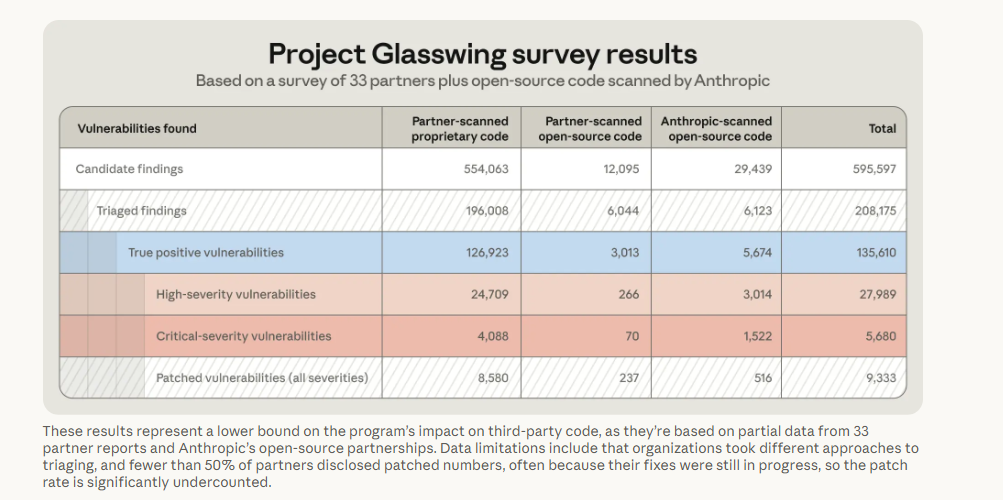
Chart: Anthropic, Expanding the Cyber Verification Program, October 6, 2026. Open the chart at full size.
These are aggregate Project Glasswing results from 33 partner reports and Anthropic's open-source scanning, not Aeon results or a Mythos 5.1-specific benchmark. Anthropic describes the data as partial: triage practices differed, and fewer than half of partners disclosed patch counts. Do not interpret candidate findings as confirmed vulnerabilities or divide these totals to estimate an overall patch rate.
Where it can fit in a security workflow
The following are potential applications we are evaluating, not measured Aeon performance results or a claim that every workflow is available under every grant.
Following a security boundary across a codebase
An authorization failure may depend on several components: the API authenticates a user, another service selects a resource, and a background worker performs an operation. Reviewing each component separately can miss the assumptions connecting them.
Model-assisted analysis can help build that map and identify where a permission check should occur. The researcher must then inspect the relevant code paths and test the suspected failure against the actual configuration.
Anthropic's separate Claude Security product illustrates this approach. Powered by Mythos 5.1, it analyzes code across files, verifies candidate findings and proposes patches for human review. Direct access to Mythos does not itself provide that entire product or its integrations. Claude Security.
Turning a suspected weakness into a testable finding
A report becomes actionable when it identifies the affected version, required privileges, relevant configuration and observable consequence.
In a controlled environment, a researcher can use model assistance to challenge a hypothesis, examine alternative explanations and propose a minimal validation test. The aim is to establish whether the boundary actually fails, not to accumulate increasingly alarming descriptions of what might happen.
Some hypotheses will be rejected. That is a useful result: a developer should not have to disprove an unsupported finding after it reaches the final report.
Supporting defensive incident and malware analysis
Incident response often involves incomplete evidence. A log entry, suspicious process or unfamiliar binary may support several explanations.
Where permitted, model assistance can help analysts connect artifacts, explain observed behavior and identify the next evidence needed. Malware and binary analysis belong in isolated environments with controlled tools. A plausible reconstruction must remain a hypothesis until the evidence supports it.
This is analyst support, not an autonomous incident commander. Containment and recovery decisions still require an accountable person with operational context.
Testing adversarial paths within written authorization
Authorized offensive testing uses an adversarial method for a defensive purpose. It asks whether a defined attacker, with defined privileges, can cross a boundary the organization expects to hold.
For AI systems, that may mean examining whether an agent can reach another tenant's data, whether an MCP tool enforces its write permissions, or whether retrieved content can induce an unintended action. MCP, the Model Context Protocol, connects AI applications to tools and data sources.
Such work requires the appropriate provider grant and written permission from the system owner. Rules of Engagement must specify targets, exclusions, permitted techniques, the test window and stop conditions. Access to a powerful model changes none of those obligations.
Helping developers repair and retest the failure
The most useful output is often a small correction to the place where the boundary should be enforced.
A researcher can use model assistance to compare repair options and draft a regression test. A developer must review whether the proposed change fixes the root cause without breaking legitimate behavior. Retesting must show both that the original failure is prevented and that the intended operation still works.
The finding should remain open until that evidence exists. A patch that compiles is not sufficient closure.
A practical example involving an MCP tool
Consider a hypothetical MCP server with a tool labeled read-only. The tool accepts an expression that can also modify application state. A user allowed to read data may therefore be able to perform an operation reserved for a higher privilege level.
The security question is whether the server enforces the claimed boundary, not whether the model can describe a dramatic attack.
An assessment would trace the expression into the operation it invokes, reproduce the behavior using disposable lab data, and determine where authorization belongs. The repair would then be tested with both permitted reads and denied writes under the lower-privilege account.
This illustrates the workflow; it is not a new Mythos finding. Aeon's public research record documents patched disclosures involving AI tooling and permission boundaries. Those historical outcomes should not be attributed to Mythos 5.1.
Protecting the investigation itself
Security artifacts are untrusted inputs. A repository file, log or retrieved document may contain instructions aimed at the assisting model. Treating those instructions as authority could compromise the investigation.
Anthropic reports stronger prompt-injection resistance for Mythos 5.1, while also documenting cases where it can bypass approvals or classifiers. These are vendor evaluation results, not a guarantee that an agent will respect every boundary. Release safety assessment.
The working environment therefore matters: restrict tools and network access, separate analysis from execution, use disposable test data, and require human approval for consequential actions. Do not rely on a prompt alone to protect production systems.
Client confidentiality requires a separate decision. CVP generally requires data retention, with exemptions for qualifying organizations; Enterprise Frontier Safeguards is rolling out separately. A grant does not automatically mean zero retention. Before supplying client material, agree on the approved account, permitted data, retention, access and handling of findings. Building a client-facing product on these capabilities is also governed separately. Current CVP guidance.
Measuring value rather than model prestige
Mythos 5.1 should earn its place in a workflow. Anthropic describes Opus 5.5 as comparable in cybersecurity, so access alone is not evidence of superiority or better economics. Opus 5.5 announcement.
For a useful comparison, define the tasks, tool permissions and acceptance criteria before running them. Measure verified findings, rejected hypotheses, investigator and reviewer time, repair quality and total cost. Include failures and recovery work, not just successful examples.
The right question is whether the workflow improves coverage or shortens the path to a verified fix without increasing operational risk. More generated findings are not necessarily more security.
Start with the system you need to secure
For teams shipping applications, APIs, AI agents or MCP integrations, begin with the boundary that matters to the business. Which identities can access the data? Which tools can change state? What evidence would demonstrate that those permissions hold?
Aeon CyberGuard provides scoped security reviews with human-verified findings, developer-ready remediation and a retest path. We are evaluating Mythos 5.1 within that approach, limited by our approved access and each engagement's authorization and data-handling requirements.
Book a free CyberGuard threat-model call to discuss your system and the assessment it needs. The initial public-exposure snapshot and call use public information only. Active testing begins only after scope and written authorization are agreed.